This accessible HTML version presents the same information as the
printed newsletter in a screen reader and mobile‑friendly format.
Thank you to everyone who entered the Surprise Spring Raffle! The
1st place winner is featured here on the cover! 2nd and 3rd place
winners will be featured on the next two newsletters.
Enjoy this piece of New Mexico from a fellow NMPSIA member!
Photo was captured while on a walk near Tiger Park in Aztec, NM.
Photo credit: Betsy K.
We would love to feature your photo in the next NMPSIA newsletter! You
can submit landscape photos taken in New Mexico for a chance to win
prizes and have your photo featured. Email your pictures to
KAYLYNN.ROYBAL@PSIA.NM.GOV.
Page 1
Benefits Corner
Benefits 101: Basic Life Coverage
A Benefit You Might Overlook but Your Family Won't
As part of your benefits, every eligible employee receives 100%
employer-paid Basic Life coverage. This coverage ranges from $10,000 to $50,000. Each district or
charter selects the coverage level, but no matter the amount,
it's a meaningful benefit provided at no cost to you. At first glance, $10,000 or even $50,000 might not seem like a
lot, especially when you think about long-term financial needs. But
that's not what this benefit is meant to do.
Having this benefit in place means your loved ones won't have
to figure out how to pay for your arrangements. That cost burden
is taken care of at no cost to you.
This coverage can help your family:
Pay for funeral and burial expenses
Cover immediate household bills
Reduce financial stress during an already difficult time
Provide space to grieve without urgent financial pressure
This is where YOU come in. A benefit only
works if the right people know about it and can access it when
needed. Take a few minutes today to make sure you understand your
coverage amount with your employer and ensure your loved ones are
informed.
To do this week
✓Name (or update) your beneficiary.
✓Keep a copy of your life insurance policy accessible.
✓Let your family (or beneficiary) know that this benefit
exists.
Summer Check-In for Your Check-Ups
Have you had your annual check up?
It's not too late to get your annual check up!
Completed your blood work? Vision and Dental exams?
It's important to keep up with all of your tests!
Are you scheduled for preventative care next year?
Make sure you and your family get on the calendar for 2027!
Summer travel plans? Worried about out of state coverage?
Our Medical carriers offer access to nationwide in-network
providers, so you and your family can get care no matter where you
are. To find an in-network provider, simply use the provider search
tools on your carrier's website or give them a call directly.
Don't forget, telehealth is available 24/7! It's a convenient way to
get care while on the go, whether your child wakes up with a cold or
needs a quick check for a sunburn. With telehealth, expert guidance
is just a call or click away, wherever your travels take you.
Update your Address, Phone Number, Email, Beneficiary, and More!
Getting the Most Out of Your Benefits: Massage & Acupuncture
Your plan includes coverage for massage therapy and acupuncture when
medically necessary. These services can help with stress, chronic
pain, headaches, and more!
You can receive up to 30 combined visits per year
for massage therapy or acupuncture (in-network).
High plan: $50 copay per visit
Low plan: 40% coinsurance after deductible
Page 2
Wellness Spotlight
Mental Health Matters. More importantly, YOUR mental health matters.
Your thoughts may be quietly draining you.
We all do it...
"I should be more productive!"
"I should have more energy..." "I should be more present."
But "should" often adds pressure without support. It can turn an
already busy day into something that feels like you're falling short
on everything. This summer, try noticing when that word shows up and
gently shift it!
Try this when you notice a "should" pop up in your head:
"I should be more productive."
→ What's one thing I can realistically accomplish today?
"I should have more energy."
→ What might help me feel even a little more rested?
"I should be more present."
→ What's one small way I can connect with this moment?
30-Second Self Check-In
Taking care of your mental health isn't a luxury. It's essential.
Ask
What do I need right now? (rest, connection, movement, quiet)
Rate
Rate your mood 1-10. 1 being not great and 10 being amazing.
Name
Name one feeling. Not just "stressed" but try tired,
overwhelmed, bored, etc.
Recipe: Zucchini Ribbon Skewers
2 medium zucchini (Use a vegetable peeler or mandolin to slice
into thin ribbons)
2 medium summer squash (Use a vegetable peeler or mandolin to
slice into thin ribbons)
3 tbsp fresh or dried parsley
Lemon sauce
6 oz unsalted butter or extra virgin olive oil
2 tsp lemon juice (more, if desired)
3 garlic cloves, minced
1/4 tsp red pepper flakes
pinch of salt and pepper
Directions
Preheat grill to medium-high heat.
Sauce:
Make the lemon sauce by combining all of the ‘sauce’ ingredients
(If using butter, melt it first)
Assemble the skewers:
Lightly brush one side of each ribbon with lemon sauce. Fold each
ribbon back and forth (like an accordion) and skewer through the
center. Add about 8 slices per skewer
Grill:
Brush skewers lightly again with lemon sauce. Grill for 2–3
minutes per side, turning 2–3 times, until lightly charred and
tender. (Usually, we would never tell a grill master how to grill)
Finish:
Lightly brush with extra butter (if desired) and sprinkle with
parsley. Serve with your choice of protein.
Page 3
Risk Resource
Summer Risk Roundup
Wildfire Safety: Defensible Fire Zones
What is defensible space, and why is it so important?
Defensible space is the buffer zone you create around your
school, outbuildings, and other structures. It reduces the risk
of fire by managing the plants, brush, trees, and other items in
the surrounding area that could ignite.
What are defensible space fire zones?
Defensible space fire zones are strategically maintained areas
around schools, homes, and communities that reduce wildfire risk
by buffering structures from surrounding vegetation. These
zones, including the 100-foot area around property green spaces
and nearby wildlands, slow fire spread and improve firefighting
conditions. Properly maintained defensible space significantly
increases a school’s chances of surviving a wildfire.
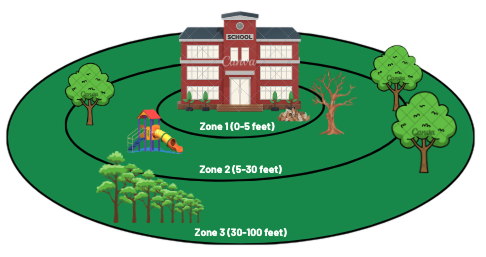
Zone 1 (0-5 feet)
This includes the structure or other outside space, as well as
fencing attached to the school and immediate landscaping from
the building to 5 feet away.
Remove all combustible materials from the roofs and gutters,
such as wood mulches, dead or dry vegetation, leaves, and pine
needles. Trim tree branches that hang over the roof, eaves,
and chimney.
Zone 2 (5-30 feet)
This includes the area from 5 feet to 30 feet away from the
school, including the property and all outbuildings.
Maintain this area by pruning and removing dead and dying
branches from well-spaced bushes and trees. Make sure to keep
this area well-maintained and watered during a hot, dry
summer.
Zone 3 (30-100 feet)
This area is farthest from the school, extending from Zone 2 to
your property's boundary, which is 30 to 100 feet.
Reduce fuels by thinning and spacing vegetation vertically and
lining up trees horizontally to interrupt the fire's path and
keep flames small and on the ground.
Summer is Perfect for Preventative Maintenance
With students out, summer is the best opportunity to address
facility needs before they become disruptions during the school
year.
Key areas to focus on:
HVAC Systems: Inspect, clean, and replace
filters to ensure reliable cooling and air quality
Playgrounds & Outdoor Areas: Check for hazards,
loose equipment, and surface wear
Electrical Systems: Inspect panels, lighting,
and emergency systems for safety and reliability
Plumbing: Check for leaks, test water systems,
and service restrooms and kitchens
Life Safety Systems: Test fire alarms,
extinguishers, and emergency exit
Building Interiors: Address flooring, trip
hazards, and general wear and tear
Preventative Roof Maintenance: Clean gutters,
remove debris, and inspect flashing to extend roof life and
prevent leaks
Prioritizing these areas helps reduce unexpected issues, improve
safety, and ensure schools are ready for a smooth start to the
year.